June 22, 2026
ISTA’s Class of 2026: Celebrating 52 Graduates
In a class spanning 25 countries, five exceptional PhDs are honored with awards
The Institute of Science and Technology Austria (ISTA) celebrated impressive achievements at this year’s graduation ceremony, with 48 new PhDs and four MSc graduates receiving their degrees. Hailing from 25 countries, the graduates completed their studies in 38 different ISTA research groups spanning the natural sciences, mathematics, and computer science. Outstanding PhD Thesis Awards went to five graduates from Austria, India, Japan, Slovakia, and Ukraine.
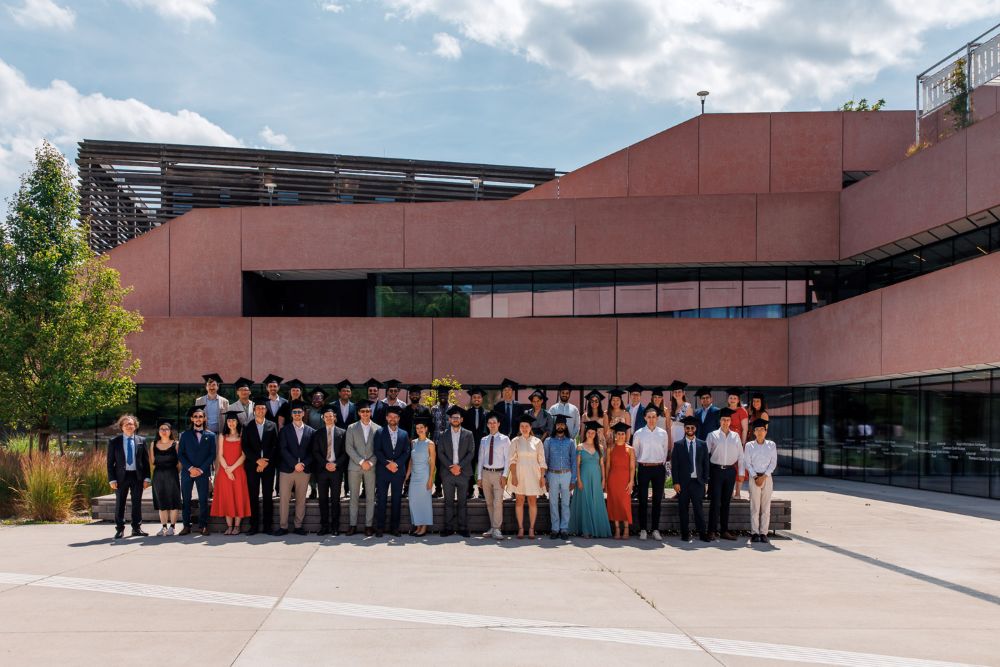
The graduates, hailing from six continents, received their degrees during a June 18 commencement ceremony at the Moonstone Seminar Center on the campus of the Institute of Science and Technology Austria (ISTA) in Klosterneuburg.
ISTA Managing Director Georg Schneider, delivering congratulatory remarks on behalf of ISTA President Martin Hetzer, underlined that educating the next generation of scientific leaders in the world is a core mission of the Institute. He stressed the crucial significance of a doctorate in a scientist’s career: “The PhD graduation is a day of open possibilities, of what the world holds for you. Congratulations!”
ISTA Graduate School Dean Mario de Bono then took to the stage to reflect on the academic journeys of the graduates, praising their perseverance and commending them for their dedication: “You have spent years to push the boundaries of science. You have shown resilience, also in the face of failure. Science is not a collection of facts. It is the process of continuously being wrong in a lot of useful ways. Your doubt is not weakness, it is strength. You leave today with something many will never achieve: a genuine tolerance for uncertainty, a trained eye for hard evidence and critical thinking,” he said.
Resilience and purpose
Following remarks by Schneider and de Bono, keynote speaker Omar K. Farha gave his commencement address. In the wide-ranging keynote, Farha underlined the importance of resilience and of purpose. Drawing upon his own experiences—from growing up in a village in the West Bank to now serving as professor of chemistry at Northwestern University in the US—he underlined that beginnings do not define endings: “Looking back, my greatest disappointments led me to unexpected successes. Your journey will not be linear either, there will be detours. Resilience is not loud, it is trying again, applying again, showing up again. If you remember nothing else from this speech, remember this: Failure is data, not an identity.”
He argued for failing intelligently, while remaining ethical and passionate in the process. “Success without purpose feels empty. If your work serves only yourself, it will never satisfy you. Think about who your work can benefit, work towards that.”
Michelle Gallei, a 2018 ISTA alum currently working for biotech company Illumina, provided a glimpse into the possible future of ISTA’s Class of 2026. “ISTA teaches you how to ask questions when you don’t have the answers yet. It teaches you how to communicate across disciplines, across perspectives, and sometimes even across uncertainty. And it teaches you how to connect—not just ideas, but people,” she said. “These friendships are one of the most valuable things you take away from ISTA. Because they don’t end when you leave. They spread out across the world. Today, my friends from ISTA are working in academia, in industry, in startups, in places and roles I could never have imagined back then. And wherever I go, I know there is someone from this community nearby.”
Outstanding PhD Thesis Awards
Five graduates are venturing out into the world with a special recognition in their pockets. The ISTA Outstanding PhD Thesis Award recognizes outstanding achievements based on nominations by ISTA professors. This year’s winners are Zuzana Dunajova from the Hannezo Group, Sadashige Ishida from the Wojtan Group, Soumyadip Mondal from the Freunberger Group, Volodymyr Riabov from the Erdős Group, and Hanna Schön from the de Bono Group.
Cells, crowds, and self-organization
Zuzana Dunajova from Žilina in Slovakia wrote her PhD thesis about “Geometry-driven self-organization of migrating cells and chiral filaments.” Her research explores how cells and proteins organize themselves—similar to how birds flock together or people move through crowds. By modeling experimental systems with computer simulations, she studied how the shape of cells and their surroundings influence how they move and work together.
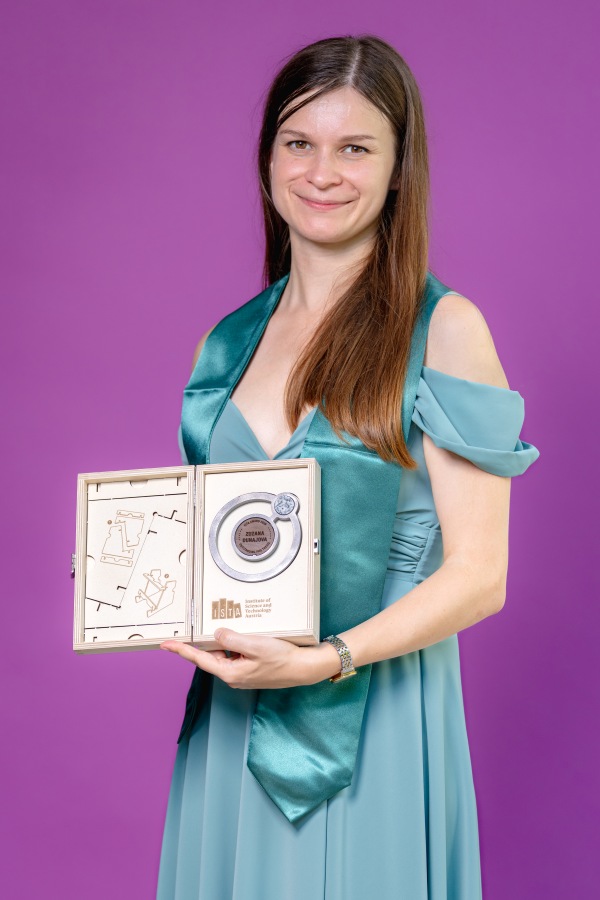
Her supervisor, Edouard Hannezo, underlines: “Zuzana uses physical theories to explain how complex living systems organize themselves — showing for instance how the flexibility of chiral filaments shapes the structures of the cell division machinery, and how the disorder of a tumor’s surroundings can by itself switch cancer cells from invading collectively to dispersing individually. She pursued this with remarkable independence, and I am certain she will excel in her scientific future.”
For Dunajova, the award is especially meaningful. “It is very motivating to see my work acknowledged, and I am very grateful for this recognition, as well as to Edouard, my collaborators, and everyone who supported me along the way,” she says.
This autumn, she will start a postdoctoral position at the Vienna BioCenter to study the biophysics of chromosome organization and DNA repair. During her PhD, Dunajova also became a mother of two. “My journey included a lot of balancing research and family life,” she notes. “I am very grateful to my husband and family for their support, patience, and encouragement.”
Geometry in real and imaginary worlds
Sadashige Ishida from Tokyo, Japan, titled his thesis “Symplectic-Prequantum Structures and Dynamics on the Codimension-2 Shape Space.” Broadly speaking, he describes his research as exploring the geometry and dynamics of nature: shapes, motions, and natural phenomena in both real and imaginary worlds.

His supervisor, Chris Wojtan, underlines Ishida’s unusual path through different disciplines: “Sadashige is one of the world leaders on the topic of simulating soap films in computer graphics. He has had a unique PhD trajectory: He jumped from computer animation, to applied mathematics, to pure mathematics quite naturally, living the interdisciplinarity we aim to foster at ISTA.”
Wojtan also highlights Ishida’s strong engagement in teaching, from classes at ISTA to physics lessons for children at a local elementary school and presentations at ISTA’s annual Open Campus.
Ishida is thankful for the support he received: “For this specific award, I am very happy because it is the result of support from many people who let me pursue my interests. It is a great opportunity to officially express my gratitude to them,” he says.
Looking ahead, he says he cannot imagine stopping research, while also keeping an open mind about possible paths: “There are many imaginary and real natural phenomena that I want to describe geometrically and investigate mathematically and non-mathematically,” he says.
Redox chemistry for better batteries
The third recipient of the award, Soumyadip Mondal from Bolpur, West Bengal, India, titled his thesis “Oxygen and Sulfur Redox: Conversion Kinetics and Phase Equilibria.” His PhD research explores the electrochemistry of oxygen- and sulfur-based systems relevant to energy storage and redox biology. Among other things, it resolves a decades-old scientific debate about singlet oxygen, a highly reactive oxygen species.
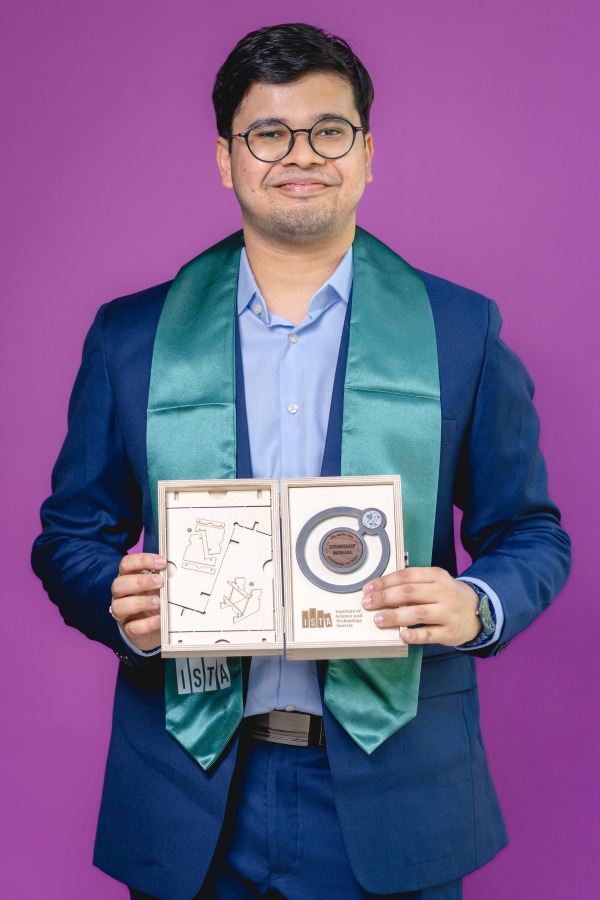
His supervisor, Stefan Freunberger, stresses the broad significance of Mondal’s work: “The implications of this work extend across life sciences, fundamental chemistry, and energy storage, culminating in a first-author publication in Nature, a testament to both its originality and its broad scientific impact,” Freunberger says.
He also praises Mondal’s role in building ISTA’s chemistry community, including his work as student representative and as a driving force behind chemISTAlk, a regular student and postdoc talk series.
For Mondal, the award is tied closely to ISTA as the place where his scientific career began. “ISTA is where my entire career was built, so getting this award is a massive boost of energy for my upcoming journey,” he says. He is currently doing a postdoc at the Fritz Haber Institute in Berlin and aims to become an independent scientist focusing on the physical chemistry behind energy-related challenges.
He adds: “Chemistry & Materials is relatively new at ISTA, and I am one of the first few graduates. This recognition is a strong indication that it meets ISTA’s standards.”
Universal patterns in randomness
Volodymyr Riabov from Kharkiv in Ukraine wrote his thesis on “Universality in Random Matrices with Spatial Structure.” He studies how randomness gives rise to universal patterns in large systems—or, as he puts it, why, in a mathematical sense, “all happy families are alike.” Random matrix theory appears in many areas, from chaotic quantum systems and high-dimensional statistics to computer science.
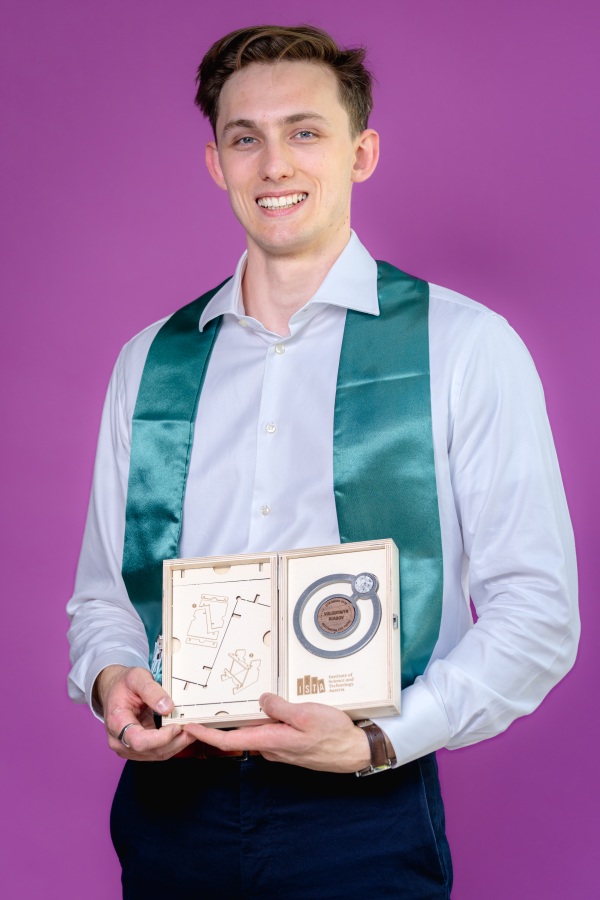
His supervisor, László Erdős, underlines Riabov’s creativity and independence: “One of the most ingenious ideas in his thesis was to develop the zigzag strategy for Wigner-type matrices with vector valued spectral parameters,” he says. “In several long discussions, I tried to save the more conventional approach with scalar valued objects but eventually had to admit that Vova was right and his vector-valued flow was very elegant.”
Riabov sees the award as a tribute also to the people around him: “It is a great honor to receive this award. More than anything, I see it as a testament to how fortunate I have been to have László as my supervisor and to work with many inspiring collaborators.”
Next, he will join New York University, where he will continue his research in random matrix theory. At the same time, he emphasizes the importance of life beyond research: “I am deeply grateful to my friends and family for keeping me grounded, for supporting me throughout, and for making my years in Klosterneuburg and Vienna so incredibly enjoyable.”
The cell’s inspection line
Hanna Schön, who was born in and grew up near Krems an der Donau, Lower Austria, chose the title “The ER complex SUTU-7/MACO-1 regulates the fate of mRNAs encoding GPCRs” for her PhD thesis. Starting from proteins of unknown function in the model organism C. elegans (a transparent worm), she discovered a mechanism that co-translationally regulates mRNAs encoding G protein-coupled receptors. These receptors are essential for many aspects of life and act like cellular “walkie-talkies.”
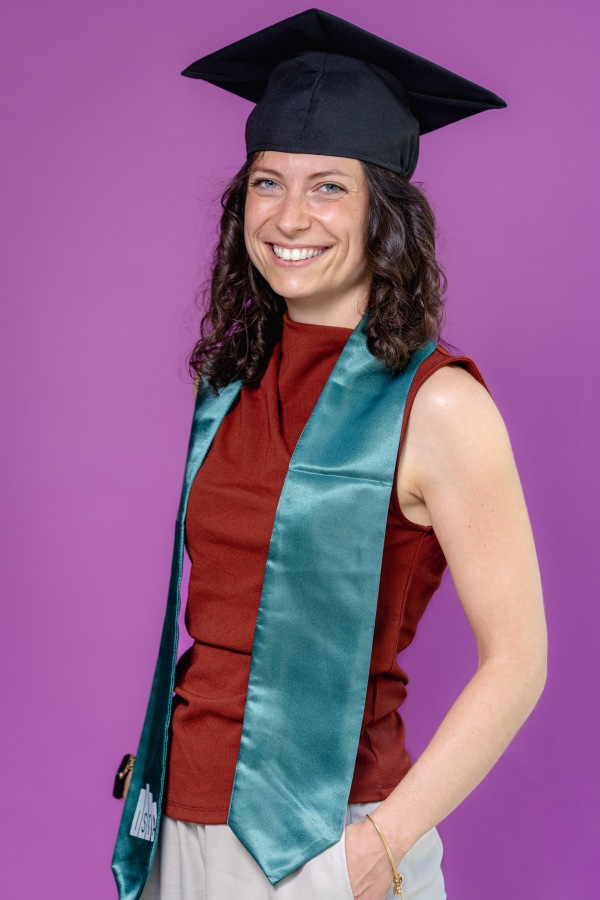
Her supervisor, Mario de Bono, underlines the scope and perseverance behind the work: “By a painstaking series of experiments combining genetics, genomics, biochemistry, molecular biology, and behavior analysis, overcoming multiple false starts, Hanna explained at molecular and circuit levels why loss of a mysterious protein disrupted behavior,” he says. “Her work is pioneering. I expect her papers will be cited for a considerable time because they open up a problem.”
He also praises her strong engagement in outreach: “Hanna has a passion for science that she communicates effectively to audiences.”
Schön is honored to receive the award. “It feels great to see years of effort and perseverance recognized,” she says. “I will celebrate with my family and colleagues because this achievement reflects not only my own efforts but also the support and encouragement I have received throughout my PhD journey.” She is now looking forward to pursuing a postdoctoral position and tackling new questions in protein folding and quality control. “My PhD has opened up many exciting avenues, and I am eager to further develop as an independent researcher while contributing to meaningful scientific discoveries.”