July 14, 2026
Quantum Bath Syncs Distant Qubits
ISTA physicists confirm 20-year-old theory that could boost quantum technology
Future quantum computing will require correlations between distant modules—a feature known as distributed entanglement. Traditionally, such entanglement has relied on active control and repeated measurements. Now, physicists at the Institute of Science and Technology Austria (ISTA) have realized a fully autonomous method for distributed entanglement using a “quantum bath” of correlated light particles. Published in Physical Review X, their work experimentally confirms a 20‑year‑old prediction and could provide a new platform for applied quantum technologies.
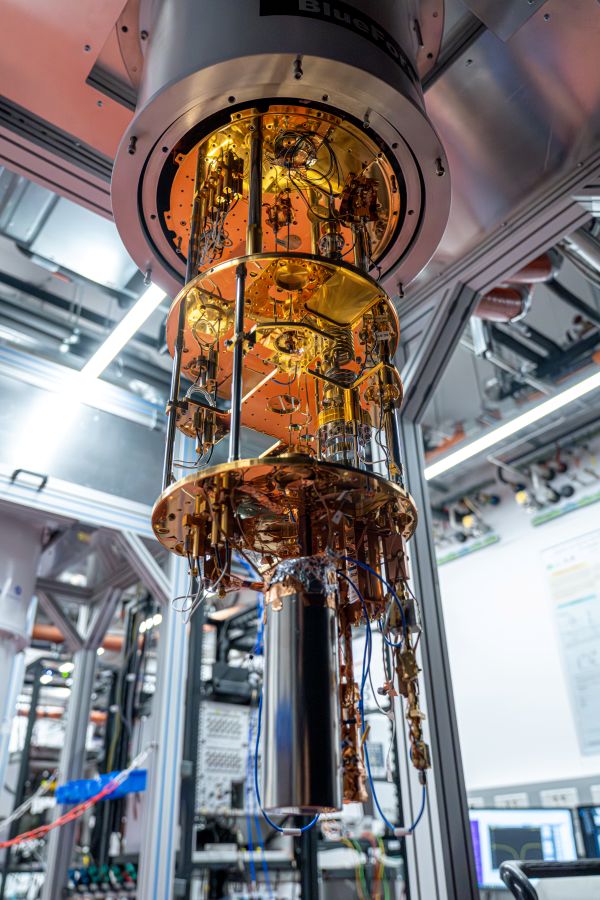
Entanglement is a central feature of quantum physics in which shared correlations exceed what classical physics theories can explain. Achieving distributed entanglement between physically separated qubits (quantum bits) could enable future advances, such as scalable quantum computers and quantum networks.
To entangle distant qubits, earlier attempts have relied on two protocols. In one approach, a single, actively controlled photon is sent from one qubit to the other. In the second approach, each qubit emits a photon that must be matched to produce entanglement. While the second method earned the 2022 Nobel Prize in Physics, it requires many repeated measurements and post‑selection, and still does not always yield entanglement.
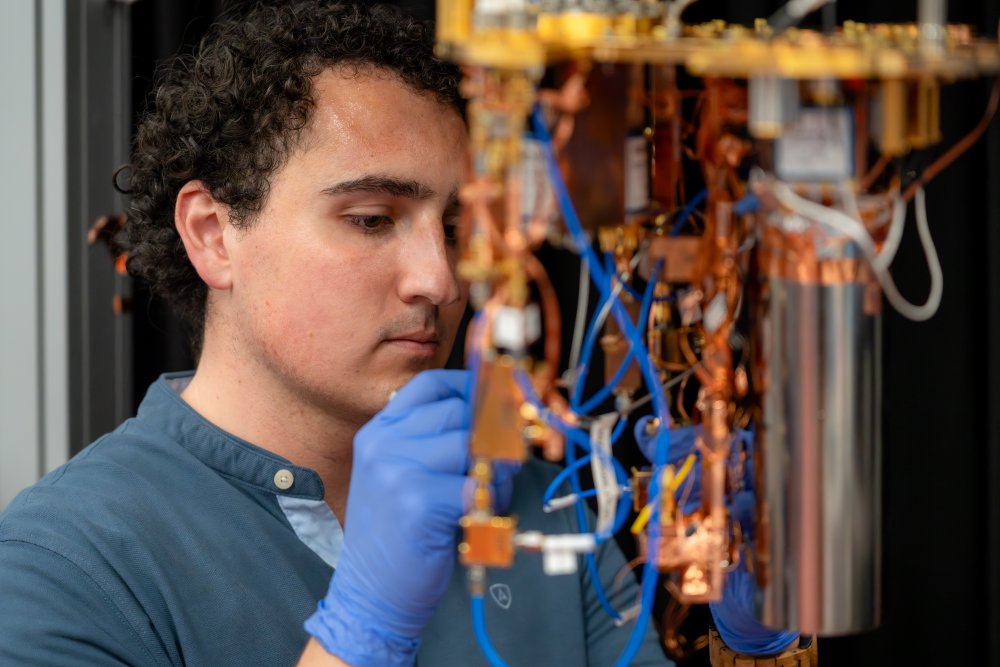
Now, PhD student Alejandro Andrés-Juanes and professor Johannes Fink at the Institute of Science and Technology Austria (ISTA) have collaborated internationally to engineer a quantum bath that autonomously synchronizes the ‘dance’ of distant qubits. By developing a prototype device that uses a common source of correlated light particles to entangle two distant qubits, the team demonstrated, for the first time, a theory proposed over 20 years ago.
Fully autonomous entanglement
Entanglement exists in various forms. Continuous-variable entangled states can be efficiently generated and are thus readily available. They resemble a pendulum, where the position and momentum vary continuously. However, most applications require “discrete-variable” systems, ‘all or nothing’ forms of entanglement that stationary qubits can interact with. Can the ISTA researchers engineer a system that bridges these two forms of entanglement?
“In this work, we aimed to overcome this mismatch between the readily available and the practically useful forms of entanglement,” says Andrés-Juanes. “By stabilizing the entangled states remotely, our approach is fully autonomous and requires no active control or measurement.”
Syncing to a common source of light particles
One of the main challenges in quantum computing applications is maintaining the qubits’ entanglement and quantum coherence.
“In our method, the quantum bath—meaning the qubits’ environment—is the source of entanglement. It creates a new ground state through a continuous stream of correlated photons,” says Fink. “This way, the entangled qubit state is stabilized, even beyond the qubits’ own ‘lifetime’, and remains always available as a resource for further quantum processing. This makes the approach conceptually significant.” When the entanglement is always available, the scientists can retrieve it on demand. This contrasts with short-lived entanglement, which they must use when it happens to be there.
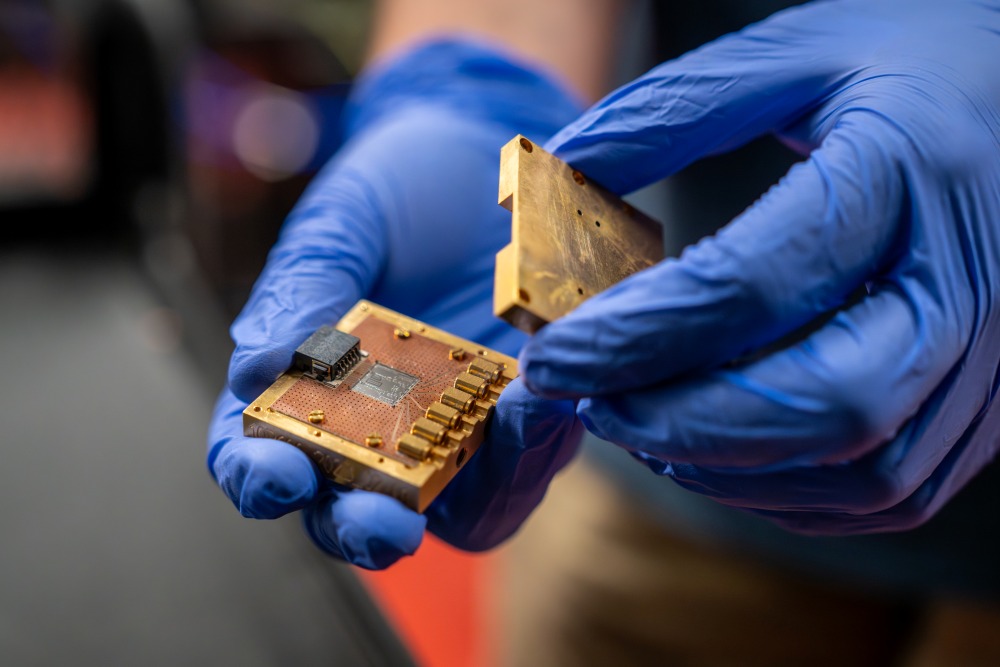
To make the qubits interact with the source of entangled photons, the team used a specific type of light particles—microwave photons. These low-energy light particles are well-suited for manipulating quantum information and form the basis of today’s leading superconducting‑qubit technology. On the other hand, optical photons are typically employed in optics and atomic physics. In addition, optical photons could help transmit quantum information between distant quantum computers via fiber optics, another research interest of the Fink group at ISTA.
Peeking into the qubit states
To verify that the qubits are indeed in sync inside the quantum bath, the team used a validation technique known as quantum tomography, named because it reconstructs a system from many ‘slices.’ “Qubits can be in a superposition of states, but all these states collapse when we measure them, leaving us with a 0 or 1 state,” says Andrés-Juanes. Using quantum tomography, the team can record measurements as short as 20–80 nanoseconds to probe the underlying qubit states. A nanosecond is one billionth of a second.
Twenty years from theory to implementation
By demonstrating entanglement between two isolated qubits via a quantum bath, the ISTA team has developed a proof-of-concept laboratory prototype. “We present a relatively simple method that could be scaled up to synchronize multiple distant qubits,” says Andrés-Juanes. While the team’s method shows promising results, other approaches involving active control of qubit states remain more efficient. “Our method currently transfers about 10% of the bath’s available entanglement.”
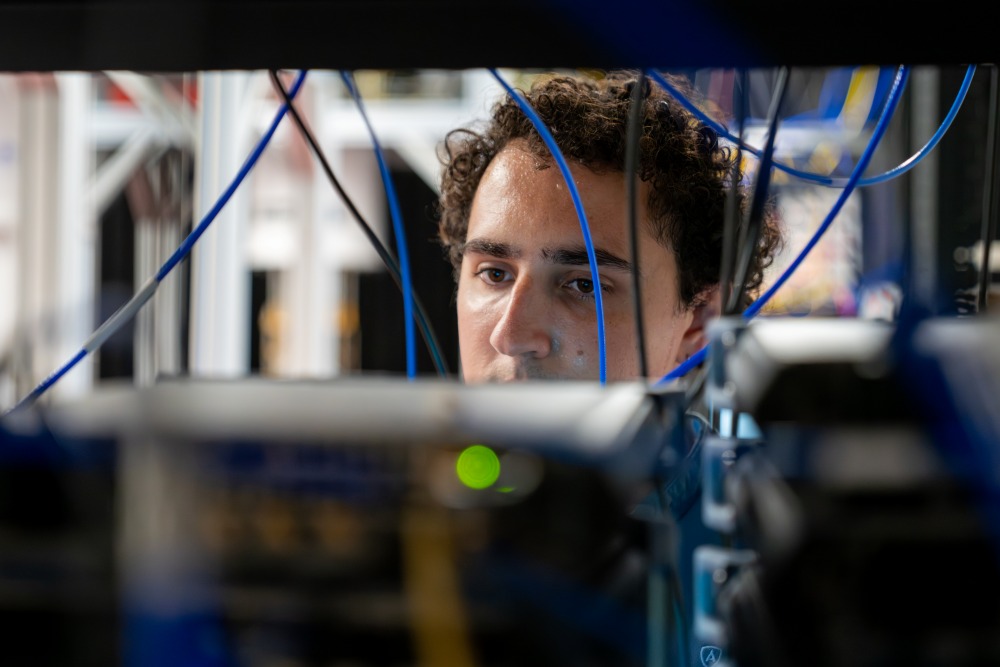
The researchers argue that the theory was proposed under idealized conditions more than twenty years ago, which may explain why it was not possible to demonstrate it sooner. “Our experiments helped us reveal several factors that may have prevented scientists from designing a functional quantum bath using a single source of correlated photons for distributed entanglement,” says Fink.
The ISTA team’s device prototype could open avenues for quantum‑optics experiments and for scaling quantum processors toward fault‑tolerant operation.
Publication:
A. Andrés-Juanes, J. Agustí, R. Sett, E. S. Redchenko, L. Kapoor, S. Hawaldar, P. Rabl and J. M. Fink. 2026. Distributing stationary qubit entanglement through a non-local squeezed reservoir. Physical Review X. DOI: 10.1103/r4jt-j39w
Funding information:
This work was funded in part by the Austrian Science Fund (FWF) through the excellence cluster quantA 10.55776/COE1 and the SFB BeyondC 10.55776/F71, as well as the European Union – NextGenerationEU, and ISTA. Further funding sources include the Horizon Europe Program HORIZON-CL4-2022-QUANTUM-01-SGA via Project No. 101113946 OpenSuperQPlus100, the European Research Council no. 101089099 (ERC CoG cQEO), and the QUANTERA project MOLAR with reference PCI2024-153449, funded by MICIU/AEI/10.13039/501100011033 and the European Union. This research is part of the Munich Quantum Valley, which is supported by the Bavarian state government with funds from the Hightech Agenda Bayern Plus.