Nanoelectronics
Physics

Georgios Katsaros
Professor
1 Career
- Since 2024 Vice President for Scientific Resources, Institute of Science and Technology Austria (ISTA)
- Since 2022 Professor, Institute of Science and Technology Austria (ISTA)
- 2016 – 2022 Assistant Professor, Institute of Science and Technology Austria (ISTA)
- 2012 – 2016 Group Leader, Johannes Kepler University, Linz, Austria
- 2011 – 2012 Group Leader, Leibniz Institute for Solid State and Materials Research, Dresden, Germany
- 2006 – 2010 Postdoc, CEA, Grenoble, France
- 2006 PhD, Max Planck Institute for Solid State Research, Stuttgart, Germany
- 2001 – 2002 Research Assistant, National Center for Scientific Research “Demokritos”, Athens, Greece
1.1 Selected Distinctions
- 2023 Organizer of the Hybrid Quantum Technologies workshop & Germanium Day 2023, ISTA / April 3 – 6, 2023
- 2022 Hitachi Cambridge Advisory Committee member
- 2015 – 2023 Elected member of the Young Academy of the Austrian Academy of Sciences (ÖAW)
- 2014 Full Professorship (W3 – chair) for Solid State Physics at the Technical University of Dresden – declined
1.2 Selected Grants
- 2023 – 2026 HORIZON-EIC-2022-PATHFINDERCHALLENGES-01-06 (101115315), Quantum bits with Kitaev Transmons, Coordinator: S. Goswami (TU Delft). Awarded overall: € 4,749,963.75, awarded to RG: € 696,602.50.
- 2022 – 2026 HORIZON-CL4-2021-DIGITAL-EMERGING-01, Integrated Germanium quantum technology, Coordinator: M. Veldhorst (TU Delft). Awarded overall: € 4,996,815.75, awarded to RG: € 260,288.75.
- 2022 – 2026 NOMIS Foundation research grant, Protected states of quantum matter, Co-Investigators: J. Fink and A. Higginbotham (ISTA). Awarded overall: € 1,650,000.00, awarded to RG: € 550,000.00.
1.3 Tech Transfer (Patents, Spin-Offs)
N/A
1.4 Selected Publications
- D. Jirovec et al., “A singlet-triplet hole spin qubit in planar ge,” Nature Materials, vol. 20, no. 8, pp. 1106–1112, Jun. 2021, issn: 1476-4660. DOI: 10.1038/s41563-021-01022-2. [Online]. Available: https://dx.doi.org/10.1038/s41563-021-01022-2.
- M. Valentini et al., “Nontopological zero-bias peaks in full-shell nanowires induced by flux-tunable andreev states,” Science, vol. 373, no. 6550, pp. 82–88, Jul. 2021, issn: 1095-9203. DOI: 10.1126/science.abf1513. [Online]. Available: https://dx.doi.org/10.1126/science.abf1513.
- M. Valentini et al., “Majorana-like coulomb spectroscopy in the absence of zero-bias peaks,” Nature, vol. 612, no. 7940, pp. 442–447, Dec. 2022, issn: 1476-4687. doi: 10.1038/s41586-022-05382-w. [Online]. Available: https://doi.org/10.1038/s41586-022-05382-w.
- M. Janík et al., “Strong charge-photon coupling in planar germanium enabled by granular aluminium superinductors,” Nature Communications, vol. 16, no. 1, p. 2103, Mar. 2025, issn: 2041-1723. DOI: 10.1038/s41467-025-57252-4. [Online]. Available: https://doi.org/10.1038/s41467-025-57252-4.
- J. Saez-Mollejo et al., “Exchange anisotropies in microwave-driven singlet-triplet qubits,” Nature Communications, vol. 16, no. 1, p. 3862, Apr. 2025, issn: 2041-1723. DOI: 10.1038/s41467-025-58969-y. [Online]. Available: https://doi.org/10.1038/s41467-025-58969-y.
2 Group Members
- Maksim Borovkov, PhD Student since 2023
- Giorgio Fabris, PhD Student since 2023
- Paul Falthansl-Scheinecker, PhD Student since 2021
- Kristen Williams Léonard, PhD Student since 2022
- Yona Anne Renee Jeanne Schell, PhD Student since 2021
- Devashish Chintan Shah, PhD Student since 2024
- Dina Sokolova, PhD Student since 2024
- Anton Bubis, Postdoc since 2022
- Ming Ni, Postdoc since 2024
- Simon Graeme Robson, Postdoc since 2023
- Kevin Etienne Robert Roux, Postdoc since 2022
- Oliver Sagi, Postdoc since 2026
3 Research
It is impossible to picture modern life without thinking of the vast amount of microelectronic applications that surround us. However, such development has only become possible with the invention of the transistor in the 1950’s. This – back at that time – few centimeters large device, led to a technological revolution. Today, the size of a transistor has shrunk to the nanometer scale, where quantum physics comes into play. Researchers are now developing new concepts and techniques that use quantum mechanics to enable information processing on entirely different principles and to create quantum processors. In this line, Loss and DiVincenzo suggested in 1998 using electron spins confined in lithographically defined quantum dots as elementary qubits to realize a quantum computer. In the past few years, holes in Germanium have emerged as one of the leading platforms for the realization of spin qubits, due to their small effective mass and large spin-orbit coupling. Furthermore, Germanium has also become an important platform for hybrid semiconductor-superconductor devices. Recent results underscore its high potential, with proximity-induced superconductivity sustaining magnetic fields in all directions. In the nanoelectronics group, we study spin qubits and hybrid superconductor-semiconductor devices in two-dimensional Germanium heterostructures, aiming to merge the fields of hybrid devices and spin qubits and enter the era of long spin-coherence hybrid devices.
3.1 Current Scientific Projects/Directions
- Hybrid semiconductor-superconductor quantum devices
- Hole spin qubits in Ge/SiGe heterostructures
- High impedance circuit quantum electrodynamics with hole spins
- Andreev spin qubits in planar Ge
3.2 Research in Focus
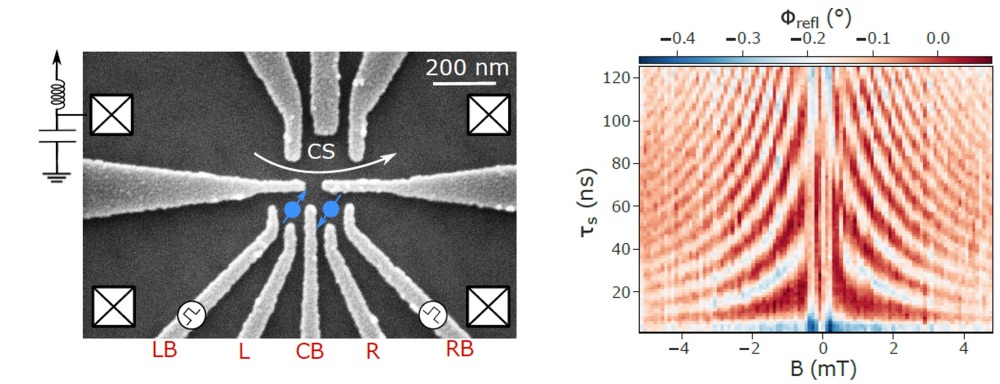
Many materials are being investigated for the realization of a quantum processor. For implementations in the solid-state domain, superconductors such as Aluminum and semiconductor elements are among the most promising. Superconducting circuits have proven to overcome classical computation on specific tasks, while group semiconductor qubits are gaining interest due to their compatibility with industrial fabrication techniques, small size, and long coherence times. The possibility of sharing the same material for both platforms would be a great technological advancement. Ge offers unique features in this respect. The Fermi pinning allows the realization of proximity-induced superconductivity, and high-fidelity spin qubits in Ge quantum dots have been demonstrated. In this work, we reported the first hole singlet-triplet qubit, realized in planar Ge, which overcame the problems faced by electron singlet-triplet qubits in GaAs and Si. By exploiting the effects of spin-orbit coupling, two-axis, in-situ tunable, electrical control was achieved, without the need for dynamical nuclear polarization or micromagnets. In addition, our work demonstrated that such qubits can be operated at out-of-plane fields below and are therefore compatible with superconducting circuits. This work was published in Nature Materials: D. Jirovec et al., Nature Materials 20, 1106 (2021).