Cellular Neuroscience
Neuroscience

Peter Jonas
Magdalena Walz Professor for Life Sciences
1 Career
- 2026 Adjunct Professor of Medical University Vienna
- Since 2022 Magdalena Walz Professor for Life Sciences, Institute of Science and Technology Austria (ISTA)
- Since 2010 Professor, Institute of Science and Technology Austria (ISTA)
- 1995 – 2010 Professor of Physiology and Department Head, University of Freiburg, Germany
- 1994 – 1995 Associate Professor, Technical University of Munich, Germany
- 1992 Habilitation, University of Heidelberg, Germany
- 1990 – 1994 Senior Postdoc, Max Planck Institute for Medical Research, Heidelberg, Germany
- 1988 – 1989 Postdoc, University of Giessen, Germany
- 1987 MD, University of Giessen, Germany
1.1 Selected Distinctions
- 2025 Third ERC Advanced Grant “CA3-SYNGRAM” (€2.5M)
- 2021 Peter Seeburg Integrative Neuroscience Prize of the Society for Neuroscience, USA ($100k)
- 2019 Elected member of EMBO
- 2018 Schrödinger Award of the Austrian Academy of Sciences (ÖAW)
- 2016 Wittgenstein Award of the Austrian Minister of Science, Research and Economy and the Austrian Science Fund (€1.5M)
1.2 Selected Grants
- 2025 – 2030 ERC Advanced Grant “CA3-SYNGRAM” € 2.5M.
- 2024 – 2029 Cluster of excellence CoE 16 “Neuronal circuits in health and disease”, acronym “GABA neurons” € 840K.
- 2024 – 2028 FWF Principal Investigator Project “Synapses, cell types, and microcircuits in the human hippocampus” € 399K.
1.3 Tech Transfer (Patents, Spin-Offs)
The Jonas group has two ongoing collaborations with Leica Microsystems. In particular, the group has developed the microslicer VT 1200, based on the previously developed principles of generation of planar vibrations. A significant income for the institute is generated on the basis of this collaboration. The Jonas group has developed software for electrophysiology, notably Stimfit, a program package for high-level quantitative analysis of synaptic currents and potentials. This analysis package is open-source software that is publicly available and is widely used in many electrophysiology labs.
1.4 Selected Publications
- Vargas-Barroso V, Watson JF, Navas-Olive A, Schlögl A, Jonas P (2026) Developmental emergence of sparse and structured synaptic connectivity in the hippocampal CA3 memory circuit. Nature Communications, accepted for publication.
- Watson JF, Vargas-Barroso V, Morse-Mora RJ, Navas-Olive A, Tavakoli MR, Danzl JG, Tomschik M, Rössler K, Jonas P (2025) Human hippocampal CA3 uses specific functional connectivity rules for efficient associative memory. Cell 188, 501–514.e18 [On the Cover; Research Highlight, Nature Reviews Neuroscience].
- Chen J-J, Kaufmann WA, Chen, C, Arai, I, Kim, O., Shigemoto R, and Jonas P (2024) Developmental transformation of Ca2+ channel–vesicle nanotopography at a central GABAergic synapse. Neuron 112, 755–771 [Featured Article; Research Highlight, Nature Reviews Neuroscience].
- Ben-Simon Y, Kaefer K, Velicky P, Csicsvari J, Danzl JG, Jonas P (2022) A direct excitatory projection from entorhinal layer 6b neurons to the hippocampus contributes to spatial coding and memory. Nature Communications 13, 4826.
- Vandael D, Borges-Merjane C, Zhang X, Jonas P (2020) Short-term plasticity at hippocampal mossy fiber synapses is induced by natural activity patterns and associated with vesicle pool engram formation. Neuron 107, 509–521.e7 [Editor’s choice, Science; Preview by Vargish GA, McBain CJ (2020) Neuron 107, 395–396].
2 Group Members
- Silvia Jamrichova, PhD Student since 2019
- Peipeng Lin, PhD Student since 2019
- Rebecca Morse Mora, PhD Student since 2020
- Priyansha Verma, PhD Student since 2024
- Subhodeep Bhattacharya, Postdoc since 2025
- Katharina Lichter, Postdoc since 2022
- Wei Liu, Postdoc since 2025
- Andrea Navas Olive, Postdoc since 2023
- Jake Watson, Postdoc since 2020
- Shubhash Yadav, Postdoc since 2025
- Florian Marr, Research Technician since 2010
- Alois Schlögl, Software Engineer and Scientific Computing since 2010
3 Research
A major goal of the Jonas group is to figure out how the properties of cells, synapses, and circuits shape higher order computations in the brain. To achieve this, we use several cutting-edge techniques: multicellular recording in brain slices, with up to 8 recording electrodes; subcellular recording from cortical presynaptic terminals, also in combination with postsynaptic measurements; in vivo recordings from identified neurons in awake, head-fixed animals; calcium imaging from neurons in vitro and in vivo, preferentially in combination with electrophysiology (“optophysiology”), and development of computational models of hippocampal circuits. In our recent research, we have focused on three key aspects. First, we have developed techniques to apply cutting-edge optophysiology to human circuits, using samples obtained by our collaborators at the Medical University Vienna during epilepsy surgery. Second, we have become interested in the physical and chemical correlates of memory, called engrams. We are currently labeling engram cells based on their activity history and immediate early gene expression, and analyze their functional and structural properties by optophysiology. Finally, we want to determine the rules of synaptic connectivity in the hippocampal circuit, including the connectivity of both pyramidal neurons and GABAergic interneurons. To achieve this, we increasingly combine cutting-edge electrophysiology with superresolution and expansion microscopy.
3.1 Current Scientific Projects/Directions
- Analysis of structural and functional connectivity of different types of CA3 pyramidal neurons (Watson and Morse et al., in preparation).
- Postnatal development of the hippocampal CA3 autoassociative memory circuit (Vargas-Barroso, accepted for publication).
- Effects of connectivity motifs on higher-order computations in mechanistic and normative hippocampal network models (Andrea Navas-Olive et al., in preparation).
- Analysis of presynaptic inhibition by GABA-B receptors in hippocampal mossy fiber terminals (Lin et al., in revision).
- Analysis of hippocampal mossy fiber transmission in humans (Jamrichova et al., in preparation).
- Identification of calcium sensors of synchronous and asynchronous transmitter release in hippocampal mossy fiber synapses (Jamrichova et al., in preparation).
- Structural changes at inhibitory synapses related to exocytosis revealed by functional electron microscopy (“flash and freeze”; Lichter et al., initial project stage).
- Effects of genetic elimination of NMDA-type glutamate receptors on postnatal development of the hippocampal CA3 autoassociative network (Yadav et al., initial project stage).
- Structural and functional properties of engram cells in the hippocampal CA3 region (Liu et al., initial project stage).
- Analysis of spatial and contextual coding in CA3 pyramidal neurons in awake behaving mice across cell types and along major hippocampal axes (Bhattacharya et al., initial project stage).
- Structure, function, and connectivity of GABAergic interneuron subtypes in humans (Verma et al., planned).
- Pattern completion in the hippocampal CA3 network in vivo (Bhattacharya et al., initial project stage).
3.2 Research in Focus
A major goal of the Jonas group is to understand how the properties of cells, synapses, and microcircuits shape higher order computations. In particular, we are interested in the hippocampal CA3 region, the largest autoassociative network in the mammalian brain, which plays a key role in learning and memory.
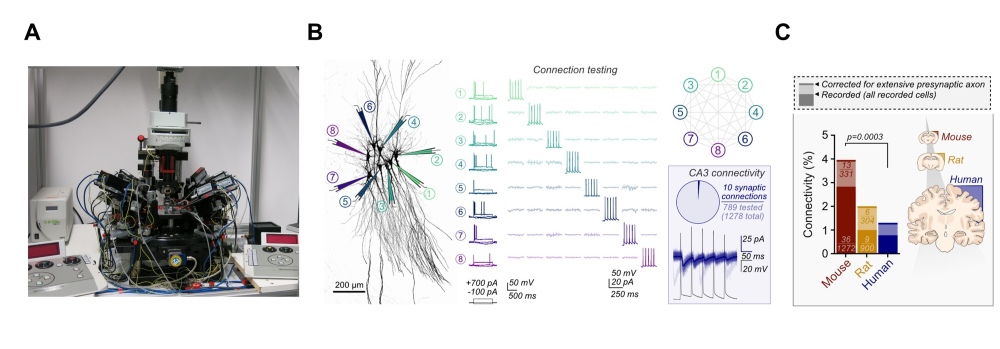
Previous studies have analyzed synapses and circuits in the hippocampal CA3 region in rats or mice. Yet, whether the properties of connectivity and synaptic properties extrapolate to humans has remained unclear. We have recently tackled this question in collaboration with the Department of Neurosurgery of the Medical University Vienna, headed by Karl Rössler. We have developed techniques to transfer tissue extracted during epilepsy surgery to ISTA and to subsequently analyze synaptic transmission by cutting-edge electrophysiology. In particular, we are interested in tissue from so called MRI-negative patients, which show minimal structural alterations of the hippocampal CA3 region. Using this approach, we were able, for the first time, to perform simultaneous recordings from to up to eight neurons (“octuple” recordings) in the human CA3 region (Figure). We found that sparse connectivity, which is a characteristic feature of the hippocampal CA3 circuit across species, is particularly prominent in humans. This corroborates our hypothesis that connectivity scales inversely with CA3 cell number, which is much higher in humans (~ 2M cells) than in mice (100k cells). However, we also found that the organization of the CA3 circuit does not follow a simple scaling rule, because dendritic length increases, whereas dendritic spine density decreases in humans. In parallel to the specific properties of connectivity, we discovered that CA3–CA3 recurrent synapses in humans have unique functional properties. Synaptic transmission shows a higher level of reliability and precision in the human than in the mouse circuit under identical conditions. Finally, we implemented the biological features of connectivity and synaptic properties into network models of realistic size. We found that several biologically observed properties improved memory storage and recall and increased the total storage capacity. Taken together, these results indicate that the human CA3 network is not simply a scaled version of that of the mouse, and that the functional properties of CA3–CA3 synapses are unique. Furthermore, our results suggest that these specific properties of the human CA3 optimize the memory function of the CA3 network. We have recently published these intriguing results in Cell (Watson et al., 2025), a leading journal in the field of life sciences. The study has also been highlighted by a cover figure in this journal. Our work has attracted a huge amount of attention in the scientific community and has also been discussed in several newspaper articles for the general public. The paper is an excellent example of efficient collaboration within an institution, i.e., the Jonas and the Danzl groups at ISTA, as well as between institutions i.e. ISTA and the Medical University of Vienna.