Stars and Compact Objects
Astronomy

Ilaria Caiazzo
Assistant Professor
1 Career
- Since 2024, Assistant Professor, Institute of Science and Technology Austria (ISTA)
- 2022 – 2024, Postdoctoral Fellow, California Institute of Technology (Caltech), USA
- 2019 – 2022, Burke – Sherman Fairchild Prize Fellow, California Institute of Technology (Caltech), USA
- 2019 PhD, University of British Columbia, Vancouver, Canada
1.1 Selected Distinctions
- 2026 Chair of the Science Organizing Committee and main organizer of the 24th European Workshop of White Dwarfs, the most important international conference in the field
- 2022 Knighted Cavaliere dell’Ordine al Merito della Repubblica Italiana, the highest-ranking honour of the Italian Republic, awarded for merit acquired for the nation in the field of science
- 2019 Sherman Fairchild Prize Fellowship
1.2 Selected Grants
- 2025 James Webb Space Telescope, program GO 9111: An Infrared View of the Type Iax Supernova Remnant Pa 30. Awarded $ 192,000.
- 2022 NuSTAR Space Telescope, program GO 8204: Constraining axions with ZTF J1901+1458. Awarded $ 82,740.
- 2021 James Webb Space Telescope, program GO 2559: Brown Dwarfs, White Dwarfs and Planetary Disks in an Ancient Stellar System. Awarded $ 311,708.
1.3 Tech Transfer (Patents, Spin-Offs)
N/A
1.4 Selected Publications
- A. Cristea et al., “A half ring of ionized circumstellar material trapped in the magnetosphere of a white dwarf merger remnant,” Astronomy & Astrophysics, Volume 706, id.A188, 35 pp., February 2026. DOI: 10.1051/0004-6361/202556432.
- T. Cunningham et al., “Expansion Properties of the Young Supernova Type Iax Remnant Pa 30 Revealed,” The Astrophysical Journal Letters, Volume 975, Issue 1, id.L7, 10 pp., November 2024. DOI: 10.3847/2041-8213/ad713b.
- I. Caiazzo et al., “A rotating white dwarf shows different compositions on its opposite faces,” Nature, Volume 620, Issue 7972, p.61-66., August 2023. DOI: 10.3847/2041-8213/ad713b.
- I. Caiazzo et al., “Probing magnetar emission mechanisms with X-ray spectropolarimetry,” Monthly Notices of the Royal Astronomical Society, Volume 514, Issue 4, pp.5024-5034, August 2022. DOI: 10.1093/mnras/stac1571.
- I. Caiazzo et al., “A highly magnetized and rapidly rotating white dwarf as small as the Moon,” Nature, Volume 595, Issue 7865, p.39-42, June 2021. DOI: 10.1038/s41586-021-03615-y.
2 Group Members
- Aayush Desai, PhD Student since 2023
- Andrei-Alexandru Cristea, PhD Student since 2023
3 Research
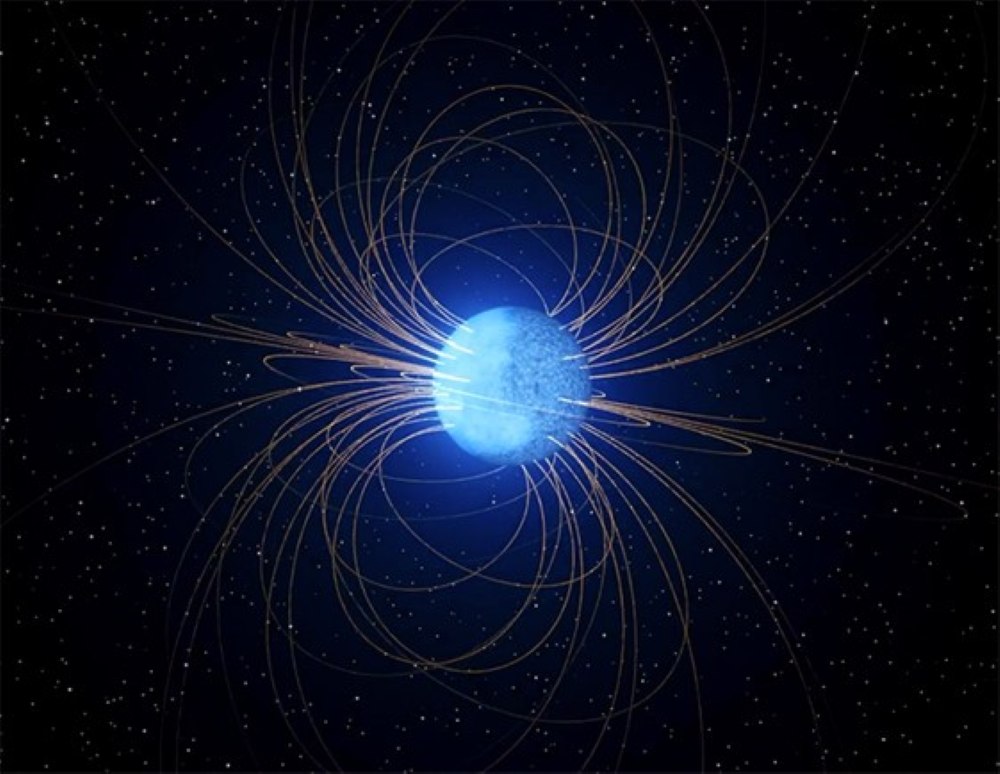
Stars and the remnants that represent the last stage in their life — white dwarfs, neutron stars, and black holes — encompass a variety of extremes that cannot ever be achieved on Earth: of gravitation, energy, density, temperature, and magnetic field. The goal of the Stars and Compact Objects research group is to further our understanding of the laws of physics by probing these beautiful and complex laboratories that populate the skies above us.
This is an exciting time for stellar astrophysics as high-cadence time domain surveys (Gaia, PTF, ZTF, ATLAS, Kepler, TESS, and, in the near future, the Vera Rubin Observatory) are revolutionizing the landscape of stellar studies by allowing the exploration of the dynamic sky. Furthermore, spectroscopic surveys are ongoing (SDSS V, DESI, WEAVE etc.), which will provide spectral classifications for millions of stars. Space missions are also opening new windows on stars and their remnants: December of 2021 alone saw the launch of the James Webb Space Telescope, with its unprecedented sensitivity in the infrared, and of the Imaging X-ray Polarization Explorer, the first mission dedicated to X-ray polarimetry. The Laser Interferometer Space Antenna, scheduled for launch in the early 2030s, will expand our reach in the field of gravitational waves.
In the Stars and Compact Objects group, we take advantage of these incredibly rich datasets to explore stellar evolution in star clusters, study compact binaries and their remnants, explore the physics of exotic white dwarfs and investigate neutron stars and black holes in the X-rays. With a mixture of observations, analysis of large datasets and theoretical work, we plan to tackle open questions about stars and their remnants that have a large impact on several fields of astrophysics.
3.1 Current Scientific Projects/Directions
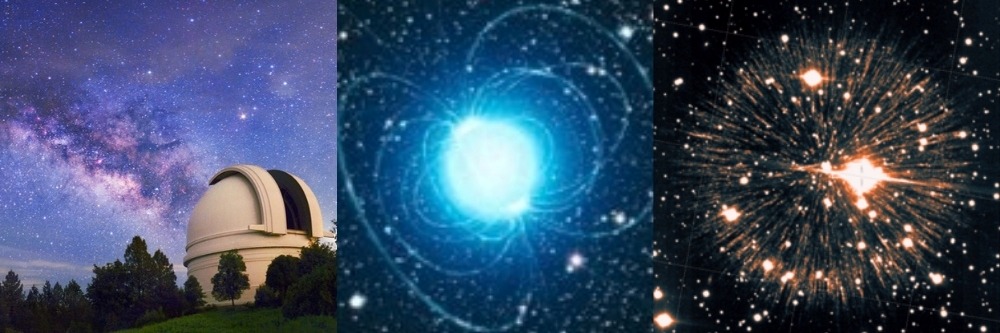
- Building a new imager, Cerberus, for the Hale telescope at Palomar Observatory.
- Exploiting current and upcoming all-sky surveys to discover exotic white dwarfs and highly magnetized white dwarfs that are the product of stellar merger.
- Simulate the merger of two white dwarfs through high-resolution magnetohydrodynamics simulations.
- Solve the mystery of the stunning remnant of the supernova detected from Earth in 1181 through multiwavelenght observations.
- Study the binary population of globular clusters with the James Webb Space Telescope and the Hubble Space Telescope.
3.2 Research in Focus
In a 2023 paper published in Nature, we reported the discovery of “Janus,” a white dwarf whose two hemispheres are dominated by different compositions: one side is made of hydrogen, the other of helium. As the star rotates every 15 minutes, its spectrum alternates between hydrogen and helium signatures, revealing a “two-faced” stellar surface.
Janus is the first known star observed to have two hemispheres dominated by entirely different chemical compositions. While astronomers had previously seen localized chemical patches on stellar surfaces, no star had ever shown such an extreme division, with one side appearing hydrogen-dominated and the other helium-dominated. We have proposed that Janus is caught in a transitional phase in which cooling and convection are transforming a hydrogen-dominated atmosphere into a helium-dominated one, while an asymmetric magnetic field causes the transition to occur unevenly across the surface.
This discovery is significant because it provides direct evidence that magnetic fields can dramatically shape the surface chemistry and evolution of white dwarfs. More broadly, it opens a new observational window onto the final stages of stellar evolution. Since about 97% of stars, including the Sun, eventually become white dwarfs, Janus may help us refine models of stellar aging, atmospheric mixing, and magnetic processes in compact stars.