Community-builder in Combinatorics
Brazil may be known as a popular vacation destination for its beautiful beaches and tropical weather, but it is also home to a bustling community of discrete mathematicians promoting a particularly ‘magical’ field: combinatorics. Among them is ISTA alum Walner Mendonça, who now teaches as an assistant professor at the Federal University of Ceará in his hometown of Fortaleza.
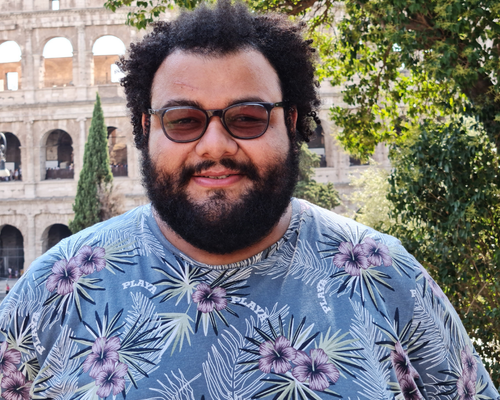
© Walner Mendonça
Combinatorics focuses on combinations and arrangements of finite structures, which were just like complicated puzzles to Walner. “The problems are easy to understand, but the solutions can be really hard, and the techniques can feel almost like magic.” Walner had studied and researched exclusively in Brazil through his PhD and was looking to gain experience in a different setting. At the same time, Matthew Kwan was setting up his research group at ISTA.
“The pandemic had made finding positions and securing visas quite challenging. Matthew is a pretty well-known guy in the combinatorics field and when he reached out to my PhD advisor about an open position, I jumped at the opportunity.” In just two months, he was heading North of the equator to ISTA to join the Kwan group as its second member and first postdoc.
Though Austria and Brazil are in different hemispheres, Walner did manage to stay connected to Brazilian culture not too far from campus. “When I first arrived at ISTA, I was temporarily living on campus and would often go to this pizzeria on the weekends by myself. There was a group of locals who I would often run into and it turns out they knew some Brazilian songs.” The group asked the owner to change the music on the speakers, and in a small restaurant in the hills of Klosterneuburg, they would sing Brazilian songs into the night.
He spent the next year at ISTA working intently on combinatorics problems and techniques, learning as much as he could in this new environment before ultimately heading back to Brazil. As an assistant professor, it is his goal to open the doors of combinatorics to new students and to expand the reach of the field. “There is a somewhat large community of combinatorics professors in Brazil working in São Paulo, Rio de Janeiro, Fortaleza, Salvador, and a few other cities and regions. These classes are often electives, and we work hard to make the field more accessible and excite students about its possibilities.”
Walner is one of several organizers of an annual combinatorics conference in Brazil, which will be held in Fortaleza this year. “We really want to attract new students and try to make it easier for them to attend.” He and other organizers find and apply for grants to cover the registration fee for students and offer financial support to those traveling from further parts of the country. It is his goal for others to feel the same magic he feels in his work. “I love academia a lot and really hope that more will see combinatorics as a field they can pursue and enjoy.”